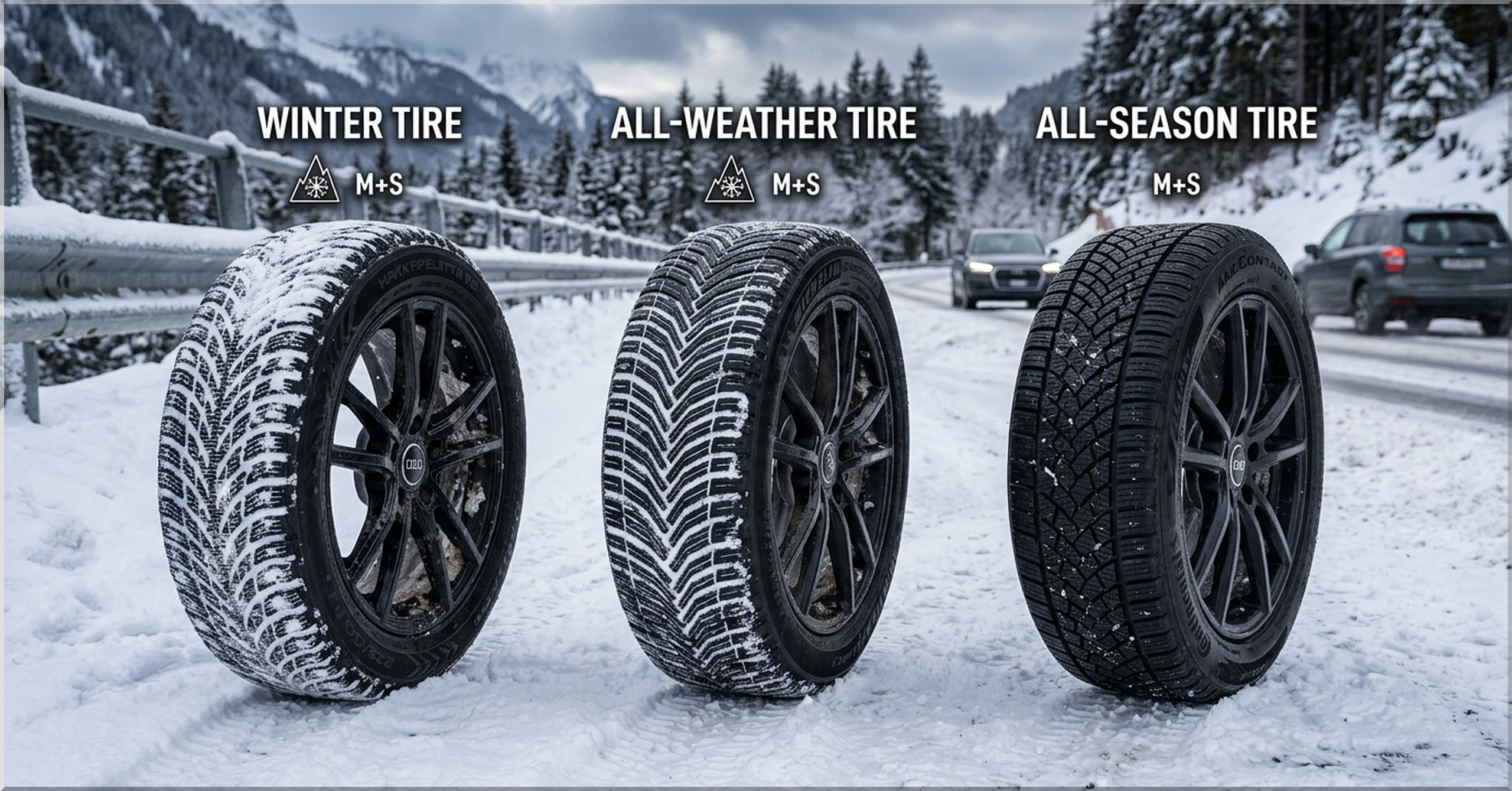
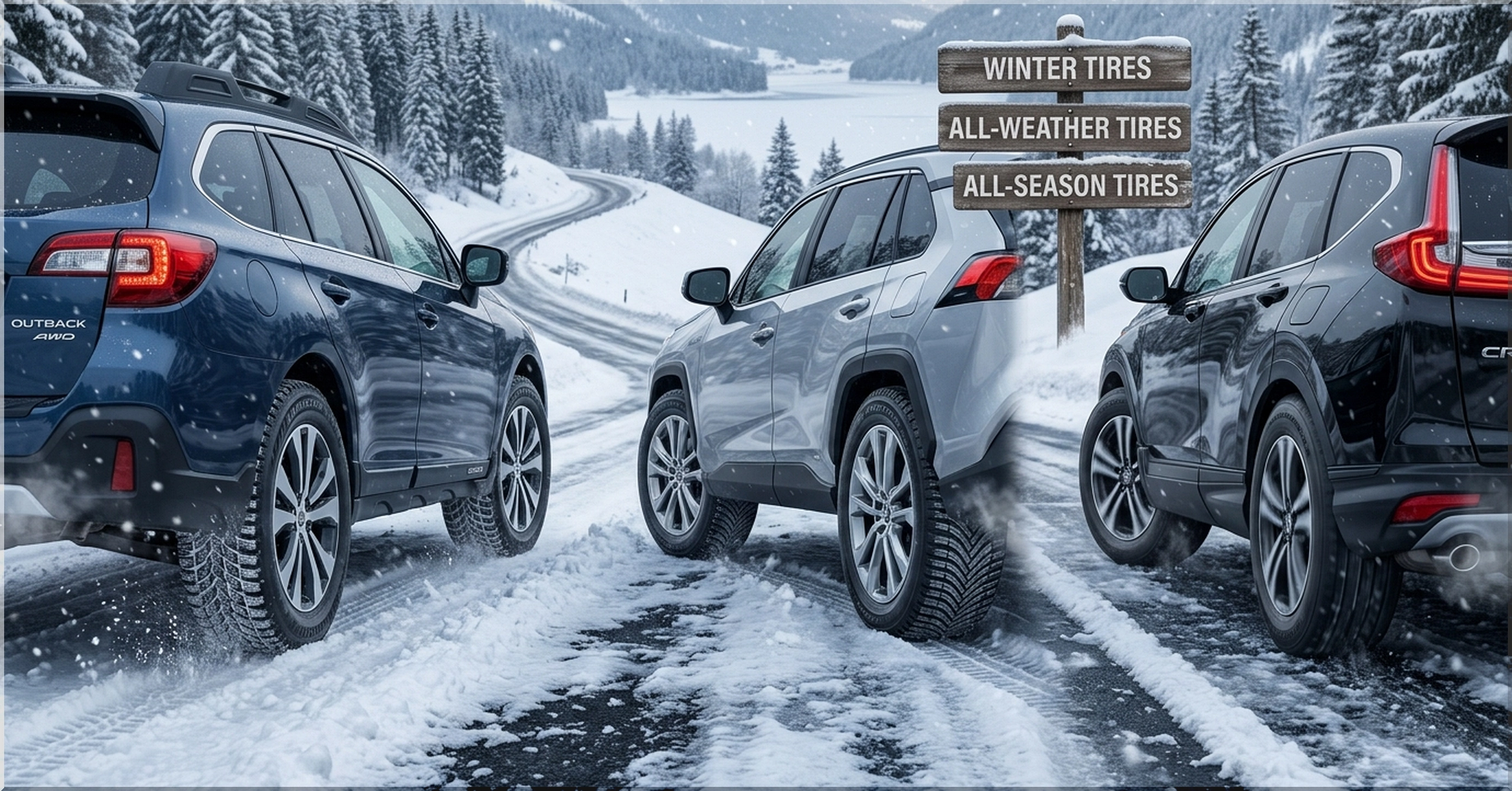
All-season, all-weather, and winter tires can look remarkably similar in a parking lot. Put them onto a cold, snowy road, however, and the differences become much more important.
The right choice depends less on the name printed on the tire and more on how cold your winters get, how often you encounter snow and ice, whether you can avoid driving during storms, and whether you want to change tires twice a year.
This decision guide helps you choose between conventional all-season tires, 3PMSF-rated all-weather tires, and dedicated winter tires without paying for capability you do not need or sacrificing winter traction you actually depend on.
Quick decision tree: which tire should you buy?
START: Do you regularly drive on snow-covered, icy, or unplowed roads?
YES -> Choose dedicated winter tires, especially if winter driving is unavoidable.
NO -> Continue to the next question.
Do you experience freezing temperatures and occasional snow each winter?
YES -> Continue to the next question.
NO -> A quality all-season tire will usually make the most sense.
Do you want one set of tires for the entire year?
YES -> Choose a 3PMSF-rated all-weather tire.
NO -> Run winter tires during the cold season and all-season or summer tires during warmer months.
Do you regularly travel to ski areas, mountain roads, or places where storms can leave roads covered in snow?
YES -> Dedicated winter tires provide the larger winter-performance margin.
NO -> A good all-weather tire can provide a practical year-round compromise.
The short answer
- Choose all-season tires if you live in a generally mild climate and see little meaningful snow or ice.
- Choose all-weather tires if you want one set year-round but still need certified snow traction.
- Choose winter tires if snow, ice, very cold temperatures, steep winter roads, or unpredictable storms are part of normal driving.
Image
What is an all-season tire?
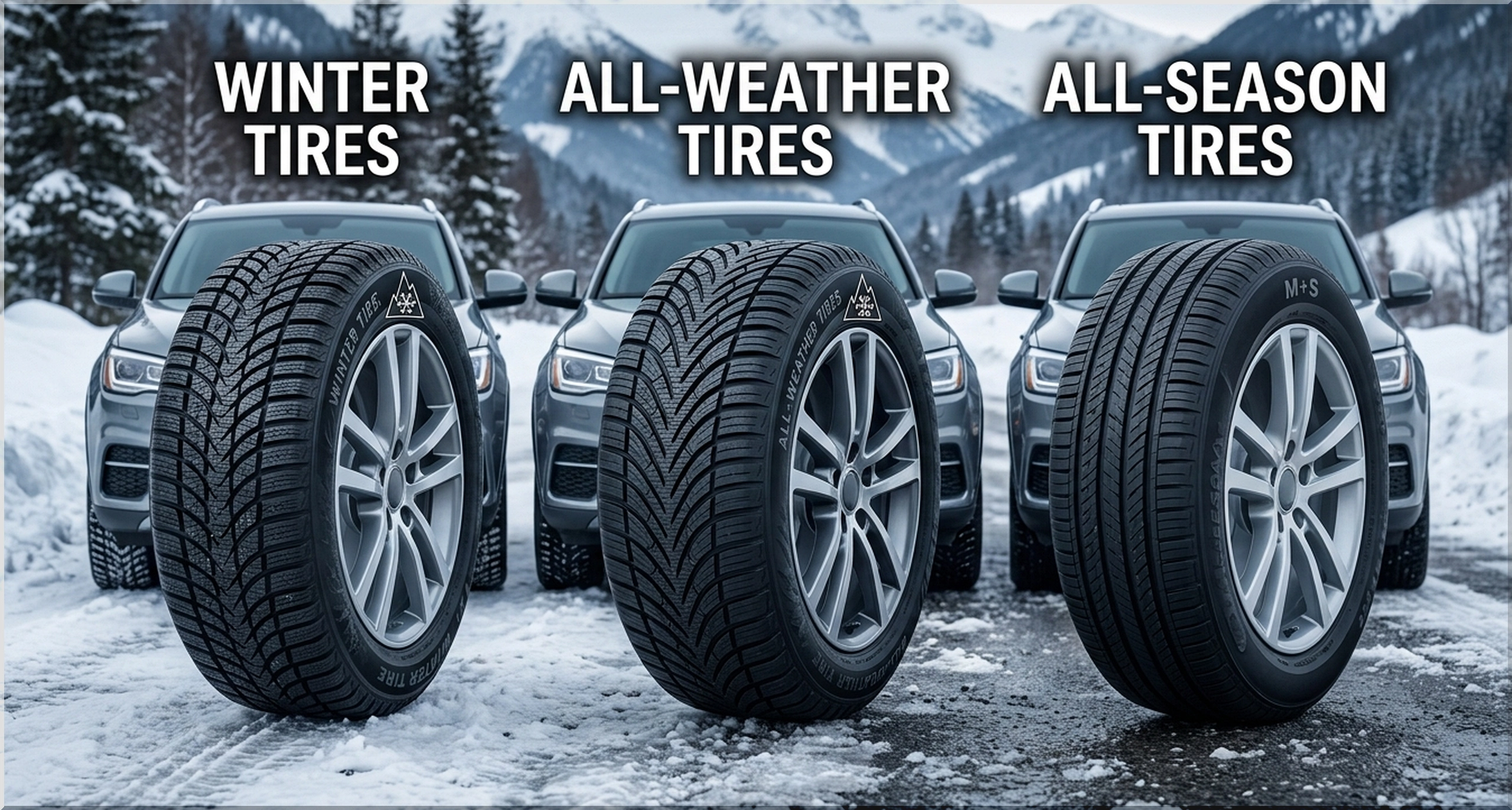
A traditional all-season tire aims to balance dry-road handling, wet traction, ride comfort, tread life, and limited cold-weather capability. It works particularly well for drivers in climates where winter mainly means cooler temperatures and rain rather than repeated snowstorms.
Many all-season tires carry an M+S or Mud and Snow marking. That marking alone should not be confused with a severe-snow performance certification.
Traditional all-season tires can handle light snow, but they generally give up traction compared with all-weather and dedicated winter tires as conditions become more severe.
All-season tires make the most sense when:
- Snowfall is uncommon or very light.
- You can stay home during the occasional major winter storm.
- Most winter driving takes place on cleared urban or suburban roads.
- You prioritize tread life, quiet highway driving, and warm-weather performance.
- Your climate spends relatively little time in serious winter conditions.
What is an all-weather tire?
In the North American tire market, all-weather commonly describes an all-season-style tire that carries the Three-Peak Mountain Snowflake, or 3PMSF, symbol and provides substantially more winter capability than a conventional touring all-season tire.
All-weather tires attempt one of the hardest jobs in tire engineering: maintaining useful winter traction while remaining practical during summer.
That makes them attractive for drivers who encounter real winter weather but do not want to store, buy, and swap two sets of tires.
All-weather tires make the most sense when:
- You experience occasional or moderate snow.
- Your winters include regular freezing temperatures.
- Most roads receive reasonably prompt plowing.
- You want to run one tire throughout the year.
- You want more winter capability than a conventional all-season tire provides.
What does 3PMSF actually mean?
The Three-Peak Mountain Snowflake symbol matters because a tire must meet an objective snow-traction performance threshold before it can carry the marking.
That makes 3PMSF much more useful for winter tire shopping than relying on M+S alone.
However, 3PMSF does not mean that every tire carrying the symbol performs like a dedicated winter tire. The certification addresses snow traction under a standardized test. It does not tell you that every 3PMSF tire will deliver equivalent braking, cornering, or ice performance.
This distinction explains how both an all-weather tire and a dedicated winter tire can carry the same mountain-and-snowflake symbol while delivering noticeably different performance on ice or deep snow.
What is a dedicated winter tire?
Image
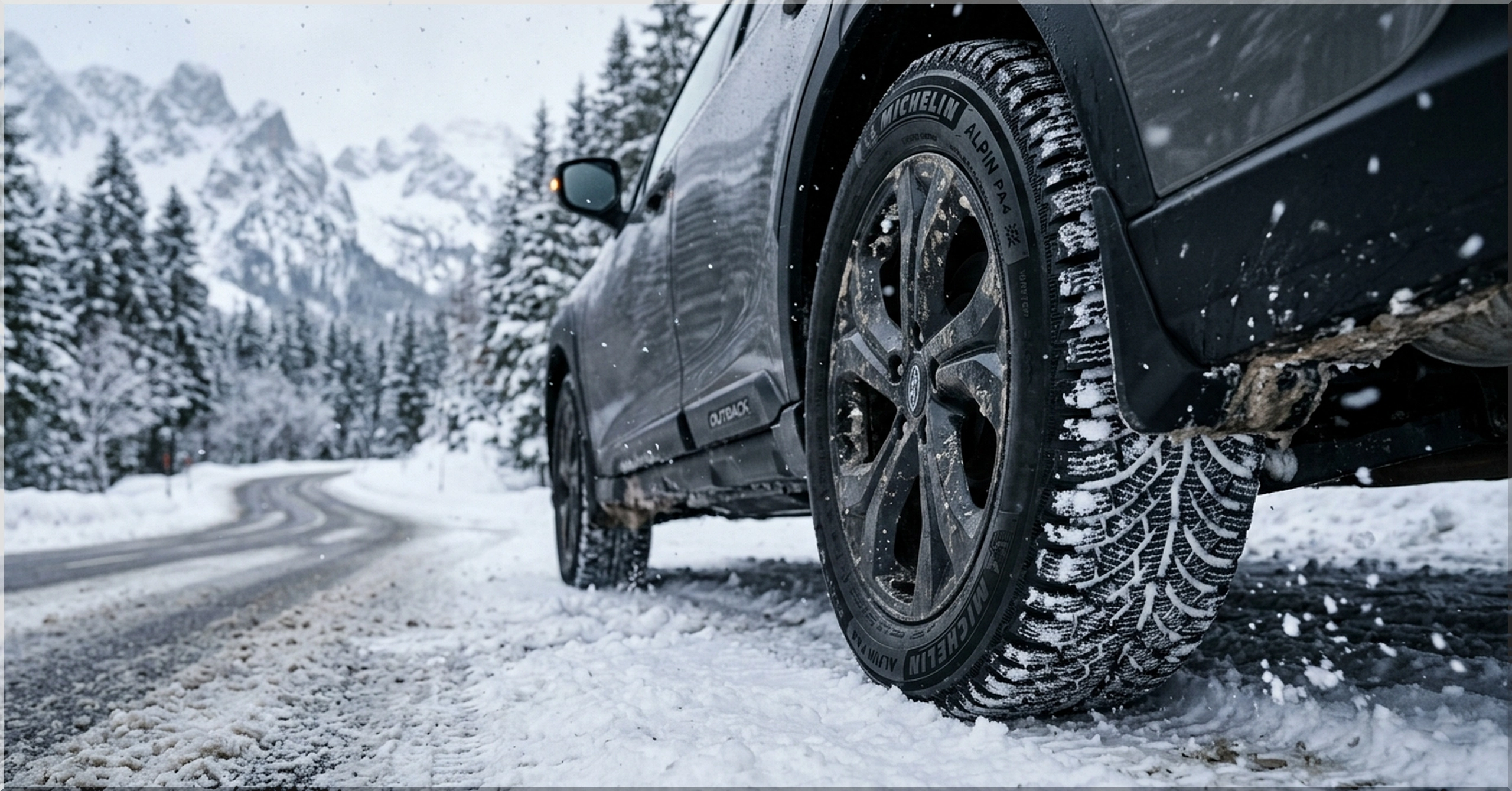
Winter tires prioritize cold-weather performance above year-round versatility. Manufacturers engineer their compounds, tread blocks, grooves, and siping specifically for snow, slush, freezing pavement, and ice.
Dedicated winter tires generally remain more effective when winter conditions become demanding because designers do not need to optimize them for hot summer pavement at the same time.
The trade-off is straightforward. You should remove winter tires when warm weather returns. Using them throughout summer sacrifices the warm-weather advantages of an appropriate all-season or summer tire and can accelerate wear.
Winter tires make the most sense when:
- You frequently drive through snowstorms.
- Your local roads remain snow-covered after storms.
- Ice and freezing rain are common.
- You commute before snowplows have cleared the roads.
- You regularly drive mountain roads or steep grades.
- Your job requires you to drive regardless of the forecast.
- You want the strongest available winter traction rather than a year-round compromise.
All-season vs all-weather tires: the critical difference
The easiest shopping shortcut is to look at the sidewall.
A conventional all-season tire may carry an M+S marking but no Three-Peak Mountain Snowflake. A tire marketed as all-weather typically carries 3PMSF certification.
That snowflake is important when winter capability matters. In Tire Rack's 2026 testing, conventional all-season products showed clear winter-performance limitations compared with all-weather and winter products. The same testing also demonstrated why an all-weather tire should not automatically be treated as a substitute for a dedicated winter tire in severe conditions.
All-weather vs winter tires: where the compromise appears
Modern all-weather tires have closed much of the gap between traditional all-season and winter tires. Products such as the Michelin CrossClimate2, Bridgestone WeatherPeak, and other 3PMSF touring tires demonstrate how much capability manufacturers can extract from a single year-round tire.
But physics still demands compromises.
A tire designed to tolerate hot highway pavement in July cannot optimize every characteristic for an icy January morning. A dedicated winter tire can use compounds and tread designs that focus much more aggressively on snow and ice.
If your biggest winter concern is an occasional snowstorm on otherwise maintained roads, that compromise may make perfect sense. If you routinely drive through deep snow or across icy surfaces, the extra winter capability of a dedicated tire becomes much more valuable.
Does the 45-degree rule decide which tire you need?
You will often hear 45°F (about 7°C) used as the seasonal tire-change guideline. It provides a useful rule of thumb, but it should not become the only factor in your decision.
As temperatures fall, tire compounds behave differently. Dedicated winter tires prioritize flexibility and grip at low temperatures, while summer-oriented compounds lose effectiveness as conditions become colder.
For an actual buying decision, ask a more useful question: What road conditions will I face when temperatures fall?
Cold but dry pavement presents a very different challenge from black ice, packed snow, freezing rain, or six inches of fresh snow.
Does AWD mean you can skip winter tires?
No. AWD changes how the vehicle sends power to its tires. It does not create additional tire grip.
An AWD SUV on inadequate tires may accelerate impressively from a snowy intersection and still struggle when the driver asks those same tires to brake or turn. USTMA specifically warns drivers not to become overconfident in four-wheel-drive vehicles because four driven wheels do not eliminate winter braking or skidding limitations.
Think of AWD as a drivetrain advantage. Tires still determine the available connection between the SUV and the road.
What about SUVs, pickups, and heavy EVs?
Vehicle weight and capability make correct tire selection even more important. Large SUVs, pickups, hybrids, and EVs can place significant loads on their tires.
Whatever seasonal category you choose, the replacement tire must still meet the vehicle manufacturer's requirements for size, load index, speed rating, and any XL or light-truck specification.
Do not buy a winter or all-weather tire solely because the diameter matches. A tire with insufficient load capacity can be inappropriate even if it physically fits the wheel.
What should you choose for a winter road trip?
Your home climate tells only half the story. Destination matters too.
A driver living in a mild city may get excellent year-round use from standard all-season tires. That changes if the same driver spends winter weekends traveling into mountain snow, ski-country roads, or regions where severe weather can develop quickly.
If winter road trips are frequent, a 3PMSF all-weather tire creates a useful baseline. Dedicated winter tires make more sense when those trips regularly involve heavy snow, ice, steep roads, or driving before roads have been cleared.
Which option costs less?
All-season and all-weather tires appear cheaper because you buy one set and avoid seasonal changeovers. Dedicated winter tires require a second set, and potentially a second set of wheels, storage space, and seasonal installation.
However, running two tire sets divides annual mileage between them. Your winter tires do not wear while the summer set is installed, and vice versa. The real long-term cost difference therefore depends on mileage, tire life, storage costs, installation costs, and how long you keep the vehicle.
Drivers should treat winter tires primarily as a traction decision rather than trying to justify them solely through cost-per-mile math.
Decision guide by driving situation
| Your driving situation | Best starting point | Why |
|---|---|---|
| Mild winters, almost no snow | All-season | Good balance of wet, dry, comfort, tread life, and occasional light-snow capability. |
| Cold winters with occasional snow | All-weather | 3PMSF winter capability without seasonal tire changes. |
| Regular snowstorms | Winter | Greater snow and cold-weather performance margin. |
| Frequent ice or freezing rain | Winter | Dedicated winter products prioritize severe cold and slippery surfaces. |
| Mountain driving and ski trips | All-weather or winter | Choose winter tires when trips are frequent or conditions are severe. |
| One tire set only, but real winter exists | All-weather | The strongest one-set compromise for many drivers. |
| Snowy climate and mandatory commuting | Winter | You cannot simply wait for roads to improve after a storm. |
| AWD SUV in a snowy region | All-weather or winter | AWD helps acceleration but does not replace winter tire traction when braking or cornering. |
Pro-Tip: shop for the symbol, then shop for performance
For drivers who need meaningful winter capability, use the 3PMSF symbol as your first filter, not your final decision.
Once you have narrowed the field to suitable tires, compare independent testing for snow braking, ice performance, wet braking, dry handling, noise, ride comfort, tread life, and rolling resistance.
Two tires can carry identical 3PMSF markings while targeting very different buyers.
Do not mix winter and all-season tires
Install the same seasonal tire category on all four wheels. Mixing substantially different traction capabilities between the front and rear axles can make vehicle behavior less predictable during braking and cornering.
This applies even to AWD vehicles. Four matching tires give the stability-control and AWD systems a more consistent traction foundation.
Final decision tree
Mostly warm or mild weather + little snow?
Choose all-season tires.
Real winter + occasional snow + you want one tire set?
Choose 3PMSF all-weather tires.
Regular snow, ice, mountain roads, or unavoidable winter commuting?
Choose dedicated winter tires.
Unsure between all-weather and winter?
Ask yourself what happens on the worst winter morning you realistically expect to drive. If staying home is an option, all-weather may offer enough capability. If you must leave regardless of snow and ice, dedicated winter tires give you more winter-focused performance.
FAQs
Are all-weather tires better than all-season tires in snow?
Generally, yes. All-weather tires typically carry the 3PMSF severe-snow marking and target substantially stronger winter traction than conventional non-3PMSF all-season tires.
Are all-weather tires as good as winter tires?
Not in every condition. Modern all-weather tires can perform very well in moderate winter weather, but dedicated winter tires retain an advantage when conditions become severe, particularly in snow and ice.
What does 3PMSF mean?
The Three-Peak Mountain Snowflake symbol indicates that the tire meets an objective performance requirement for severe-snow traction. It does not mean every 3PMSF tire delivers identical winter performance.
Is M+S the same as 3PMSF?
No. M+S and 3PMSF represent different things. For drivers shopping specifically for tested snow capability, the 3PMSF symbol provides the more meaningful performance qualification.
Do I need winter tires with AWD?
AWD does not eliminate the need for appropriate winter tires. AWD can improve acceleration, but braking and cornering still depend heavily on tire grip.
Can I leave winter tires on all year?
Dedicated winter tires target cold-weather use. Switch to an appropriate warm-weather tire once winter ends rather than using winter tires as a permanent year-round solution.
Can all-weather tires stay on all year?
Yes. That is their primary advantage. They combine year-round usability with 3PMSF-rated snow capability, though performance varies significantly among tire models.
Bottom line
There is no universal winner in the winter vs all-season vs all-weather tire debate. All-season tires suit mild climates. All-weather tires offer a strong one-set solution for drivers who face occasional or moderate winter weather. Dedicated winter tires make the most sense when snow, ice, extreme cold, or winter mobility genuinely matters.
The key is to buy for the conditions you cannot avoid, not the conditions you hope to encounter.
Image Gallery
- 10 views