Swapping winter and summer tires is only half the job. How you store the unused set can affect rubber condition, wheel finish, tire shape, and how ready the tires are when the next season arrives.
The basic rule is simple: keep stored tires clean, dry, cool, dark, and away from ozone, petroleum products, and unnecessary heat. Then store them in the correct position depending on whether the tires remain mounted on wheels.
This seasonal tire storage checklist covers everything from labeling tire positions to cleaning, bagging, stacking, inspecting, and reinstalling the set several months later.
Quick tire storage guide
| Storage question | Best practice |
|---|---|
| Best location | Cool, dry, clean indoor space away from direct sunlight |
| Tires mounted on wheels | Stack horizontally or hang from a suitable wheel rack |
| Unmounted tires | Store upright for household seasonal storage and reposition periodically |
| Clean before storage? | Yes. Remove road grime, salt, brake dust, stones, and moisture |
| Use tire dressing? | No. Tires do not need dressing or shine products before storage |
| Use storage bags? | Yes, indoors when practical, after the tires are completely dry |
| Store near a furnace or generator? | No. Avoid heat and equipment that can generate ozone |
| Check before reinstalling? | Yes. Inspect age, tread, cracks, damage, foreign objects, and inflation pressure |
Why proper tire storage matters
Tires continue to age even when the vehicle is not moving. Rubber compounds can change because of time and environmental exposure, while poor storage can accelerate deterioration.
The biggest enemies of a stored tire include:
- Direct sunlight and UV exposure
- Ozone from some electrical equipment
- Extreme heat
- Moisture
- Gasoline, oil, solvents, and other chemicals
- Physical deformation from poor stacking or hanging
A garage can therefore be an excellent tire-storage location or a poor one. A dark corner away from chemicals and electrical equipment works well. A tire leaning beside a sunny window, furnace, battery charger, or gasoline container does not.
Image
Seasonal tire swap checklist: before removing the tires
Do a little preparation before the wheels come off the vehicle. The information you record now can make the next installation easier and help identify abnormal wear early.
- Record each tire's position. Mark front left, front right, rear left, and rear right.
- Measure tread depth. Record the measurements so you can compare wear across the set.
- Inspect the tread. Look for nails, screws, stones, cuts, and unusual wear.
- Inspect both sidewalls. Check for cracking, cuts, bulges, or impact damage.
- Check the wheels. Look for bends, cracks, corrosion, curb damage, or damaged lug holes.
- Note directional tires. Record rotation direction before removing them.
Why you should mark each tire's position
Do not rely on remembering where every wheel came from six months later. Mark the positions before storage using removable labels, chalk, tire markers, or tags.
A simple system works:
- FL: Front left
- FR: Front right
- RL: Rear left
- RR: Rear right
These labels help you plan the appropriate tire rotation when the set goes back on the vehicle. They also make it easier to spot a tire that wore substantially faster than the others.
Clean tires before storing them
Seasonal tires collect road salt, brake dust, dirt, sand, oil residue, and small stones. Do not pack all of that away for several months.
How to clean tires for storage
- Rinse away loose dirt.
- Wash the tire with water and an appropriate cleaner.
- Scrub dirt from tread grooves and sidewalls.
- Remove stones and other debris lodged in the tread.
- Clean the wheels if the tires remain mounted.
- Rinse thoroughly.
- Let everything dry completely before storage.
Moisture trapped inside a storage bag can work against the whole process, particularly around wheels and metal components. Never bag a wet tire-and-wheel assembly.
Do not apply tire dressing before storage
The glossy sidewall treatment that looks good at a car show does not improve seasonal tire storage. Modern tire compounds already contain materials designed to help resist environmental degradation.
Store the tires clean and dry rather than coating them with tire shine, dressings, petroleum products, or unknown chemicals.
Should you put tires in plastic bags?
For clean, dry tires stored indoors, individual storage bags can help isolate the rubber from environmental exposure. Sealed plastic bags can also help reduce exposure to ozone when used correctly.
Before sealing a tire:
- Make sure the tire is completely dry.
- Remove as much excess air from the bag as practical.
- Seal the bag securely.
- Keep the bag away from heat, sharp objects, and chemicals.
Do not confuse an indoor tire bag with an outdoor tarp. Tires stored outside require different ventilation considerations because a sealed waterproof cover exposed to changing temperatures can trap heat and moisture.
Where should you store seasonal tires?
Indoor storage is the preferred choice. A clean, dry, well-ventilated area with mild temperatures and little or no direct light offers the best environment.
Good options can include:
- An interior garage storage rack
- A dry basement
- A climate-controlled storage room
- A tire dealer's seasonal storage service
Keep tires away from ozone sources
Ozone can attack rubber. That means the darkest corner of the garage is not automatically safe if powerful electrical equipment sits next to your tire stack.
Avoid storing tires beside equipment such as:
- Electric motors
- Generators
- Battery chargers
- Welding equipment
- Other ozone-generating electrical devices
Keep tires away from chemicals
Do not store tires beside gasoline, motor oil, solvents, or volatile chemicals. Avoid direct contact with petroleum-based products entirely.
How to store tires mounted on wheels
A complete tire-and-wheel assembly behaves differently in storage because the wheel supports the tire's shape.
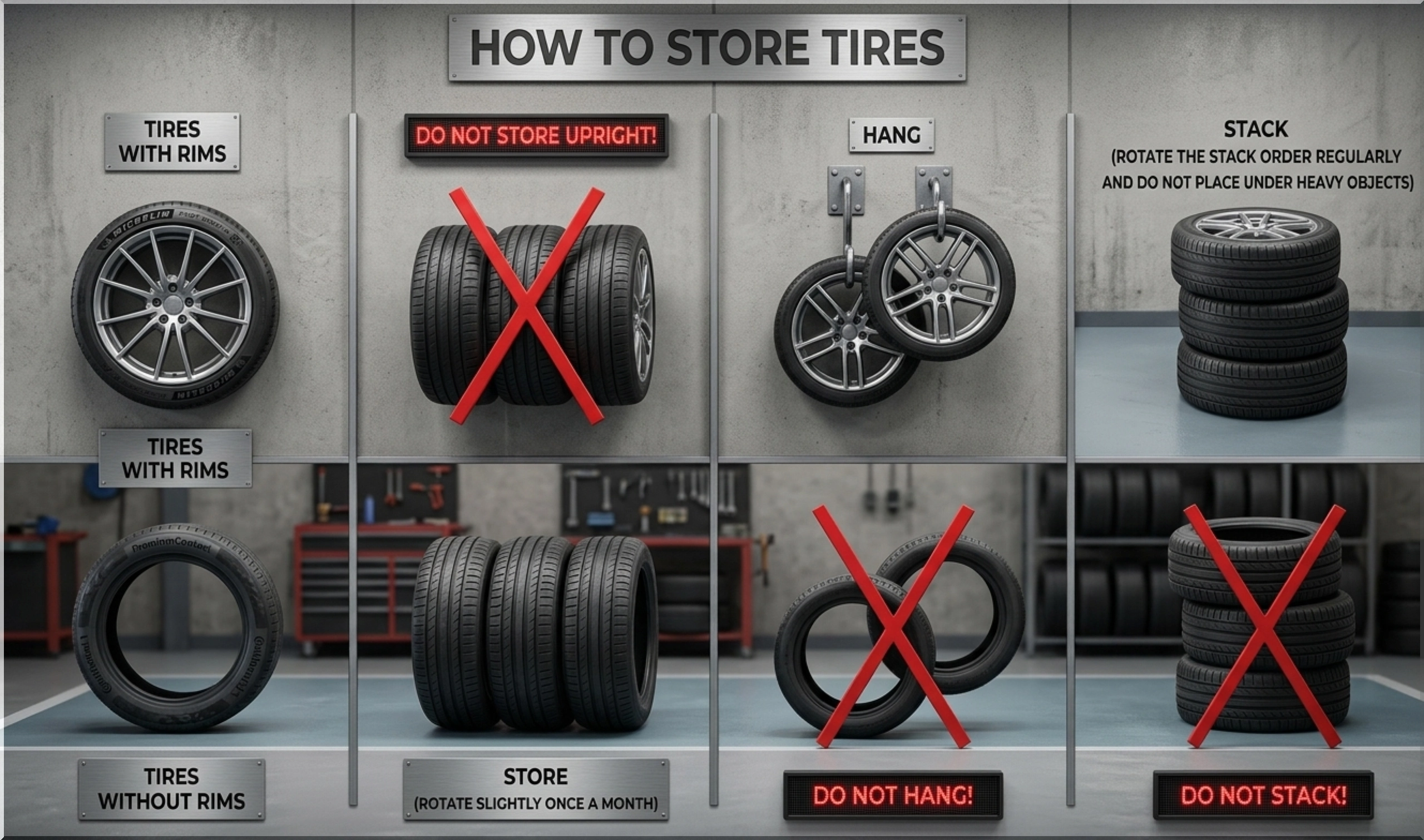
For mounted seasonal tires, common manufacturer guidance favors two methods:
- Stack the assemblies horizontally.
- Hang them from a properly designed wheel rack.
Do not build a dangerously tall stack. Keep the stack stable and place it on a clean, smooth surface or suitable rack.
If you hang mounted assemblies, support them through the wheel rather than hanging the load from the rubber tire itself.
How to store tires without wheels
For typical home seasonal storage, unmounted passenger-car tires should generally be stored upright on their tread rather than hanging them.
Reposition or rotate upright tires periodically so the same section of tread does not carry the load for the entire storage season.
Never hang an unmounted tire from a hook. Concentrating the tire's weight at one point can distort it.
A note about stacking unmounted tires
Industry recommendations vary slightly here. Carefully stacked horizontal storage can be acceptable when the stack remains stable and does not place excessive weight on the tires at the bottom. Other tire manufacturers recommend upright storage for typical passenger-car tires that are not mounted on wheels.
For a homeowner storing one seasonal set, upright storage is the simple conservative choice. Follow the tire manufacturer's specific instructions if they differ.
Mounted vs unmounted tire storage
| Storage method | Mounted on wheels | Unmounted tires |
|---|---|---|
| Stack horizontally | Yes | Manufacturer guidance varies; avoid excessive stacking |
| Hang from wheel rack | Yes | No |
| Stand upright | Not generally required | Yes |
| Store outdoors | Avoid when possible; indoor storage is preferred | |
Can you store tires outside?
Indoor storage is better. If outdoor storage becomes unavoidable, do not simply throw the tires behind the garage and cover them with a black tarp.
Outdoor tires should:
- Remain raised off the ground.
- Stay away from black asphalt and other heat-absorbing surfaces.
- Remain protected from direct sunlight.
- Use an opaque, waterproof covering.
- Receive enough ventilation to avoid trapping heat and moisture.
An airtight plastic storage bag makes sense for a dry tire inside a controlled environment. An airtight outdoor enclosure baking in sunlight can create a hot, humid chamber. Storage conditions matter as much as the cover itself.
What if the tires stay on a stored vehicle?
Long-term vehicle storage requires a slightly different approach. If possible, remove vehicle weight from the tires according to the vehicle manufacturer's approved storage procedure.
If the vehicle must remain on its tires:
- Park on a firm, clean, reasonably level surface.
- Remove unnecessary cargo to minimize tire loading.
- Maintain the recommended inflation pressure.
- Include the spare tire in pressure checks.
- Move the vehicle periodically to reduce prolonged deformation in one contact area.
For long-term storage, moving a normally stored vehicle periodically can help reduce prolonged deformation in one contact area. Certain high-performance tire constructions may require more frequent movement, so follow the vehicle and tire manufacturer's instructions for performance cars.
Check the DOT date before putting tires away
Storage does not stop tire aging. Before putting the set away, find the DOT Tire Identification Number and record the manufacturing date.
The final four digits identify the production week and year. For example:
DOT date 2424 = the 24th week of 2024.
Recording the date at every seasonal swap prevents an older low-mileage tire from disappearing into the rotation simply because its tread still looks deep.
Seasonal tire reinstallation checklist
Do not move a stored set directly from the rack onto the highway. Give each tire another inspection first.
- Check the DOT manufacturing date.
- Inspect the tread. Look for foreign objects, cuts, cracking, or unusual wear.
- Inspect both sidewalls. Watch for bulges, deep cracking, cuts, or storage damage.
- Inspect the bead area. Look for damage before mounting an unmounted tire.
- Inspect the wheels. Check for cracks, bends, corrosion, and bead-seat damage.
- Check tread depth. Confirm that the set remains appropriate for the coming season.
- Review the position labels. Plan the correct rotation pattern.
- Set cold tire pressure. Use the vehicle's tire placard, not the maximum pressure printed on the tire.
- Reset or relearn TPMS if required. Some vehicles need a relearn when switching between wheel sets.
- Torque the wheel fasteners correctly. Use the vehicle manufacturer's specification and tightening sequence.
Pro-Tip: inspect the set before storing it, not six months later
If one tire has a nail, sidewall cut, bent wheel, or questionable tread depth, deal with it before storage. Otherwise, the problem will be waiting for you on the first cold morning of winter or the first warm weekend of spring.
A seasonal swap is an ideal time to make replacement decisions because all four tires are already accessible and you can compare tread wear across the set.
Common tire storage mistakes
- Storing wet tires: Clean them, but allow them to dry completely first.
- Leaving tires in sunlight: UV exposure accelerates deterioration.
- Keeping them beside a generator or electric motor: Ozone can damage rubber.
- Storing them beside gasoline or oil: Petroleum products and solvents do not belong near tires.
- Hanging unmounted tires: Store them upright instead.
- Creating an unstable wheel stack: Keep stacked assemblies low and secure.
- Applying tire shine before storage: Clean and dry is enough.
- Forgetting tire position: Label every tire before removal.
- Ignoring tire age: Storage preserves condition; it does not stop aging.
- Installing without inspection: Check condition, pressure, tread, and age before returning the set to service.
Printable seasonal tire swap checklist
Before storage
- □ Mark FL, FR, RL, and RR positions
- □ Measure and record tread depth
- □ Check DOT manufacturing date
- □ Inspect tread and sidewalls
- □ Inspect wheels for bends, cracks, and curb damage
- □ Remove stones and debris
- □ Wash tires and wheels
- □ Dry completely
- □ Bag individually if storing indoors and appropriate
- □ Choose a cool, dry, dark location
- □ Keep away from petroleum products and solvents
- □ Keep away from ozone-generating equipment
- □ Store mounted and unmounted sets in the correct position
Before reinstalling
- □ Inspect for cracking, bulges, cuts, and foreign objects
- □ Recheck tread depth
- □ Review tire age
- □ Inspect wheel condition
- □ Plan the correct rotation pattern
- □ Set tire pressure to the vehicle placard specification
- □ Install using the correct wheel-fastener torque
- □ Complete TPMS relearn if required
- □ Watch for vibration, noise, pulling, or air loss after installation
Image

FAQs
Is it better to store tires standing or lying down?
It depends on whether the tires are mounted on wheels. Mounted tire-and-wheel assemblies can be stacked or hung from a suitable wheel rack. For typical household storage, unmounted passenger tires are best stored upright and repositioned periodically.
Can I stack winter tires?
If the winter tires remain mounted on wheels, stacking them horizontally is a common recommended method. Keep the stack stable and avoid excessive height. For unmounted tires, follow the tire manufacturer's instructions; upright storage is the conservative household approach.
Should I put winter tires in plastic bags?
You can place clean, completely dry tires in individual sealed bags for indoor storage. The bags help limit exposure to ozone and environmental contamination.
Can tires be stored in an unheated garage?
A dry, shaded garage can work, but avoid extreme temperatures, sunlight, moisture, chemicals, and ozone-producing equipment. Manufacturer-specific requirements should take priority, especially for specialty performance tires.
Can I store tires outside for the winter?
Indoor storage is preferred. If outdoor storage is unavoidable, keep the tires off the ground and protect them with an opaque waterproof cover that allows ventilation rather than trapping heat and moisture.
Should I use tire shine before storage?
No. Clean and dry the tires instead. Tire dressings and gloss products are not required for seasonal storage.
Do stored tires still age?
Yes. Storage can protect tires from damaging environmental exposure, but it does not stop rubber aging. Check the DOT manufacturing date and inspect the tires before returning them to service.
What pressure should stored tires have?
Before putting stored tires back into service, inflate them to the vehicle manufacturer's recommended cold pressure shown on the vehicle placard. A compact temporary spare may require a considerably higher pressure.
Bottom line
Good tire storage is mostly about controlling the environment. Clean the tires, dry them completely, label their positions, protect them from sunlight, ozone, heat, moisture, and chemicals, and store them according to whether they are mounted on wheels.
Then treat the next seasonal swap as an inspection, not simply an installation. Check tire age, tread, sidewall condition, wheel damage, inflation pressure, and rotation position before driving. A few minutes at each seasonal change can protect a tire set that may cost well over $1,000 to replace.
Image Gallery
- 41 views