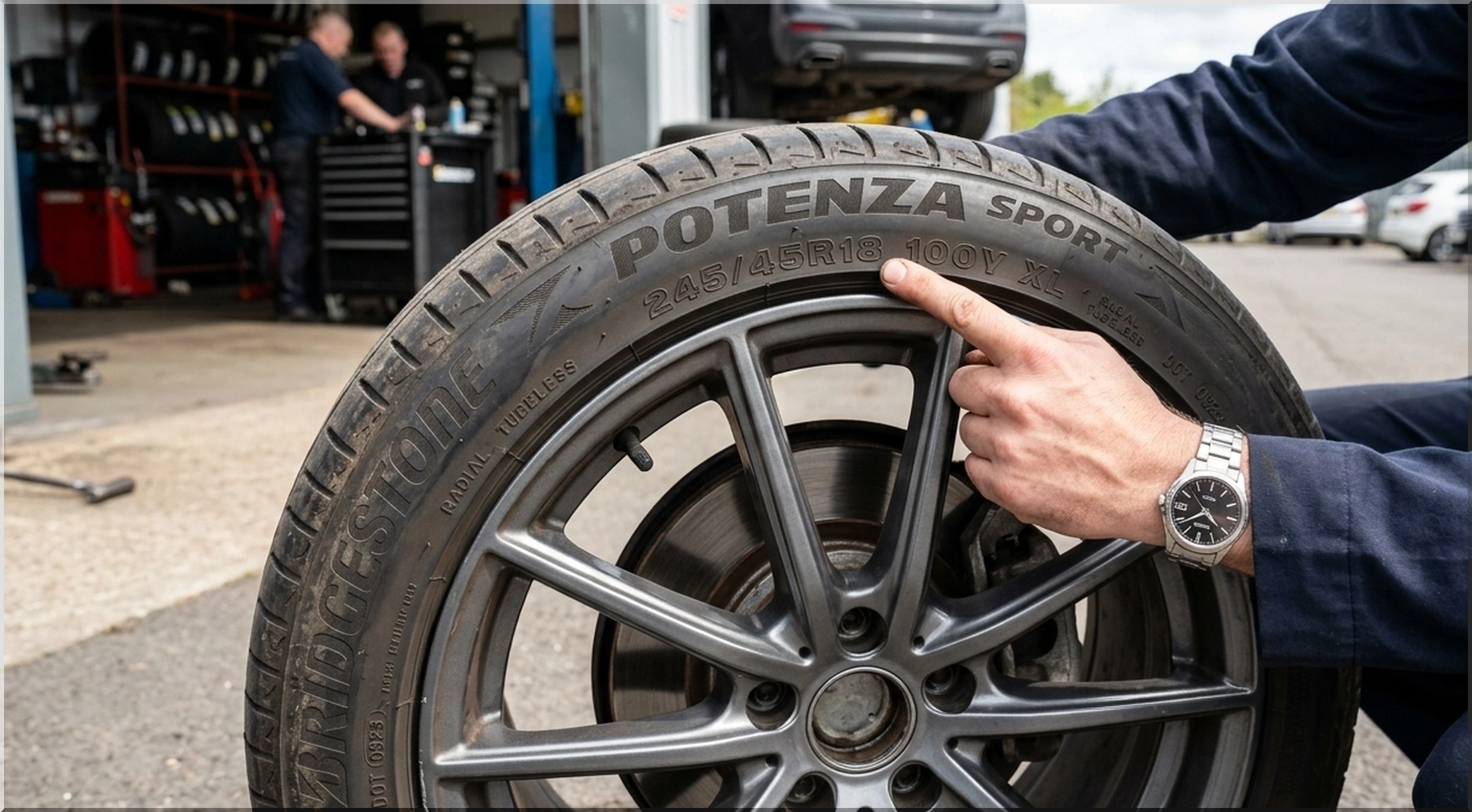
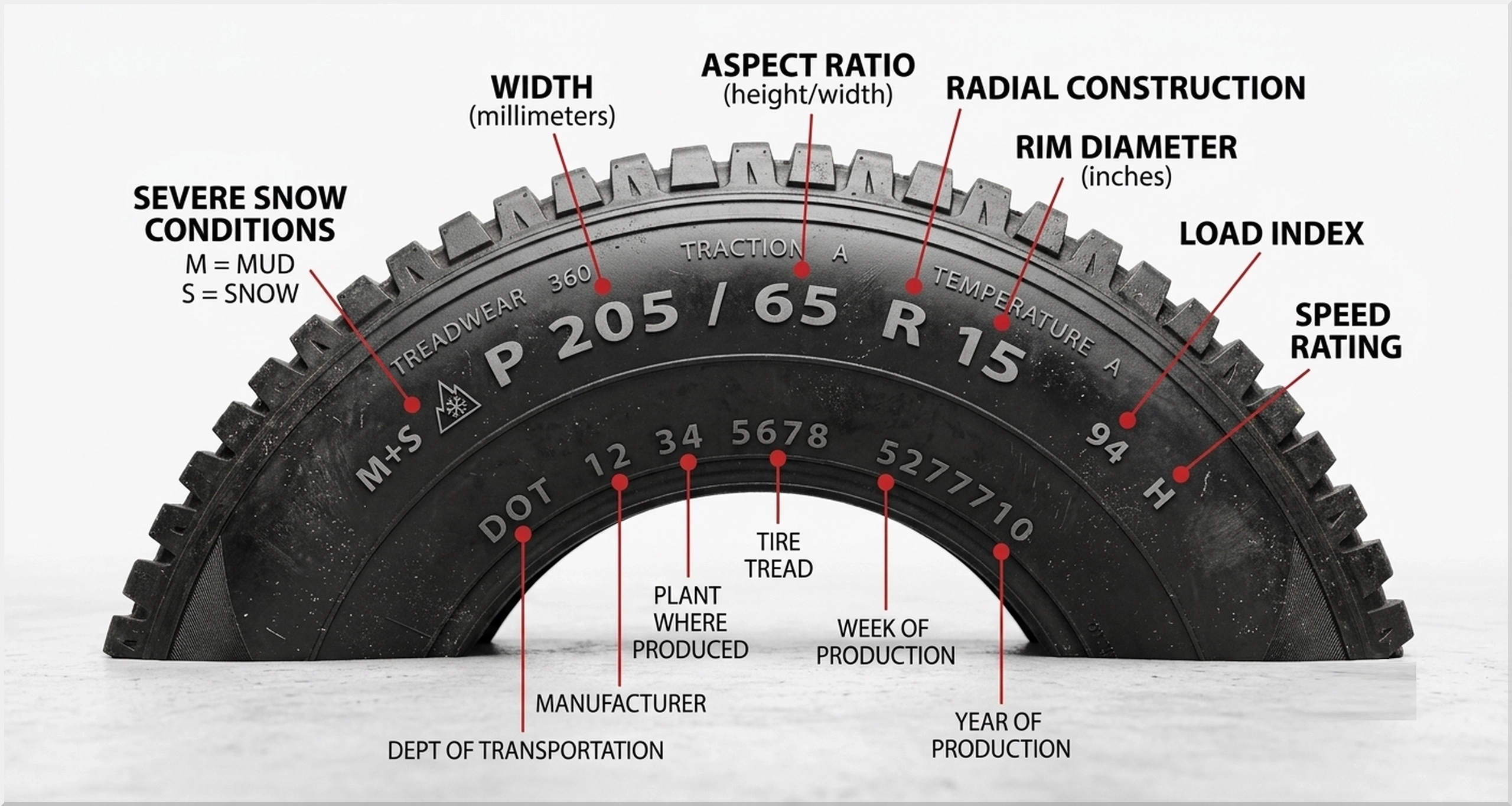
The numbers on a tire sidewall look like an engineering password, but they tell a simple story. They show the tire's width, sidewall height, wheel diameter, construction type, load capacity, speed capability, age, and sometimes winter certification. Read them correctly and you can buy the right replacement tire without guessing.
This guide breaks down the sidewall code using real examples, including passenger tires, SUV tires, light truck tires, performance tires, XL tires, and temporary spares.
Quick example: 225/65R17 102H
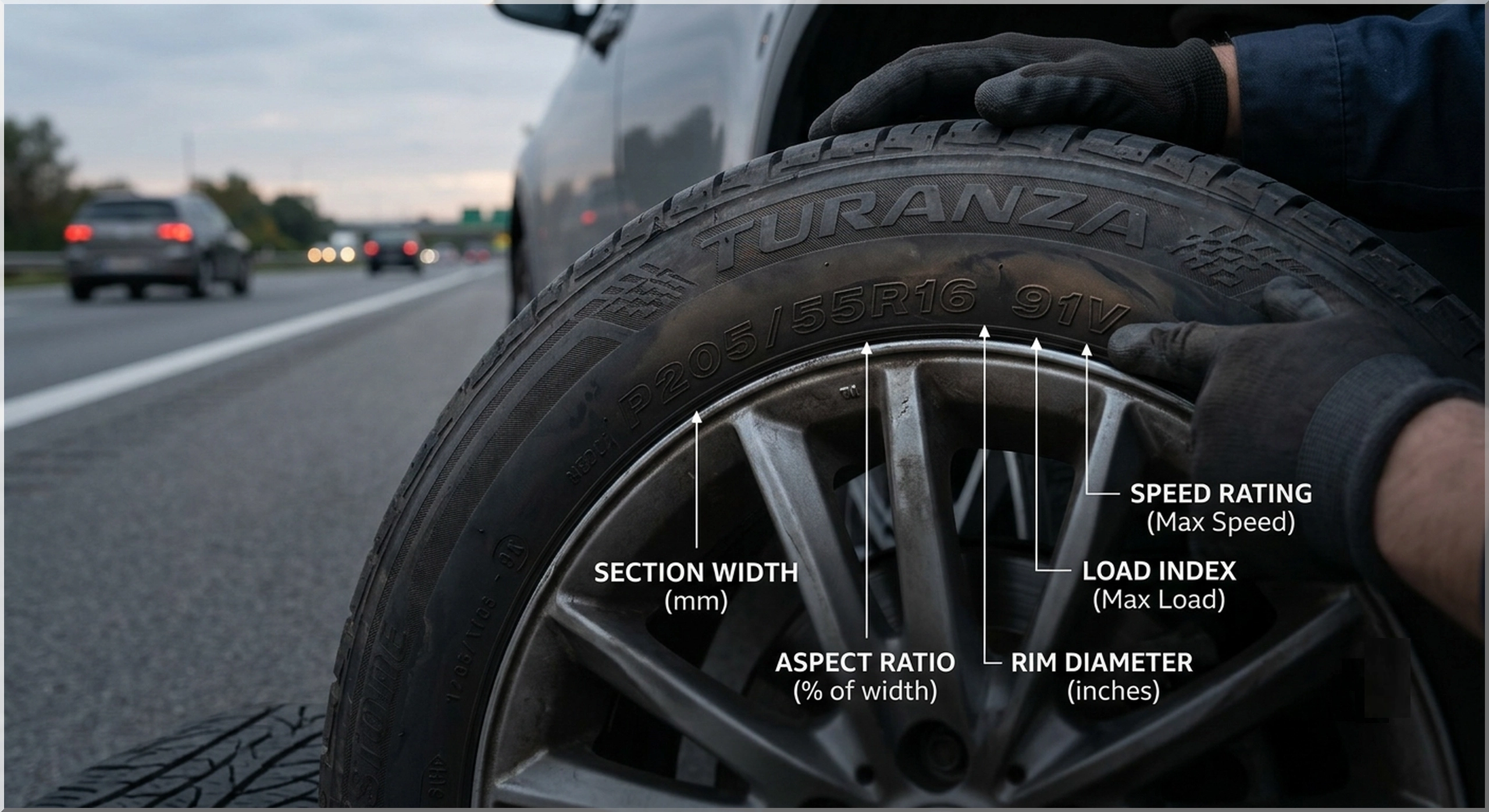
Start with a common SUV tire size: 225/65R17 102H.
| Marking | Meaning | Plain-English translation |
|---|---|---|
| 225 | Section width | The tire measures about 225 mm wide from sidewall to sidewall. |
| 65 | Aspect ratio | The sidewall height equals 65% of the tire width. |
| R | Radial construction | The tire uses radial internal construction, standard on modern passenger vehicles. |
| 17 | Wheel diameter | The tire fits a 17-inch wheel. This number must match your wheel exactly. |
| 102 | Load index | The tire can carry a specific maximum weight when properly inflated. |
| H | Speed rating | The tire meets a specific maximum speed capability under controlled conditions. |
Definitions
- Section width: The tire's nominal width in millimeters.
- Aspect ratio: The sidewall height as a percentage of the tire's width.
- Construction letter: The internal tire structure. Most modern car tires use R for radial.
- Wheel diameter: The wheel size, measured in inches.
- Load index: A number that maps to the maximum weight one tire can carry when properly inflated.
- Speed rating: A letter that maps to the tire's tested speed capability while carrying its rated load.
How to read the tire width
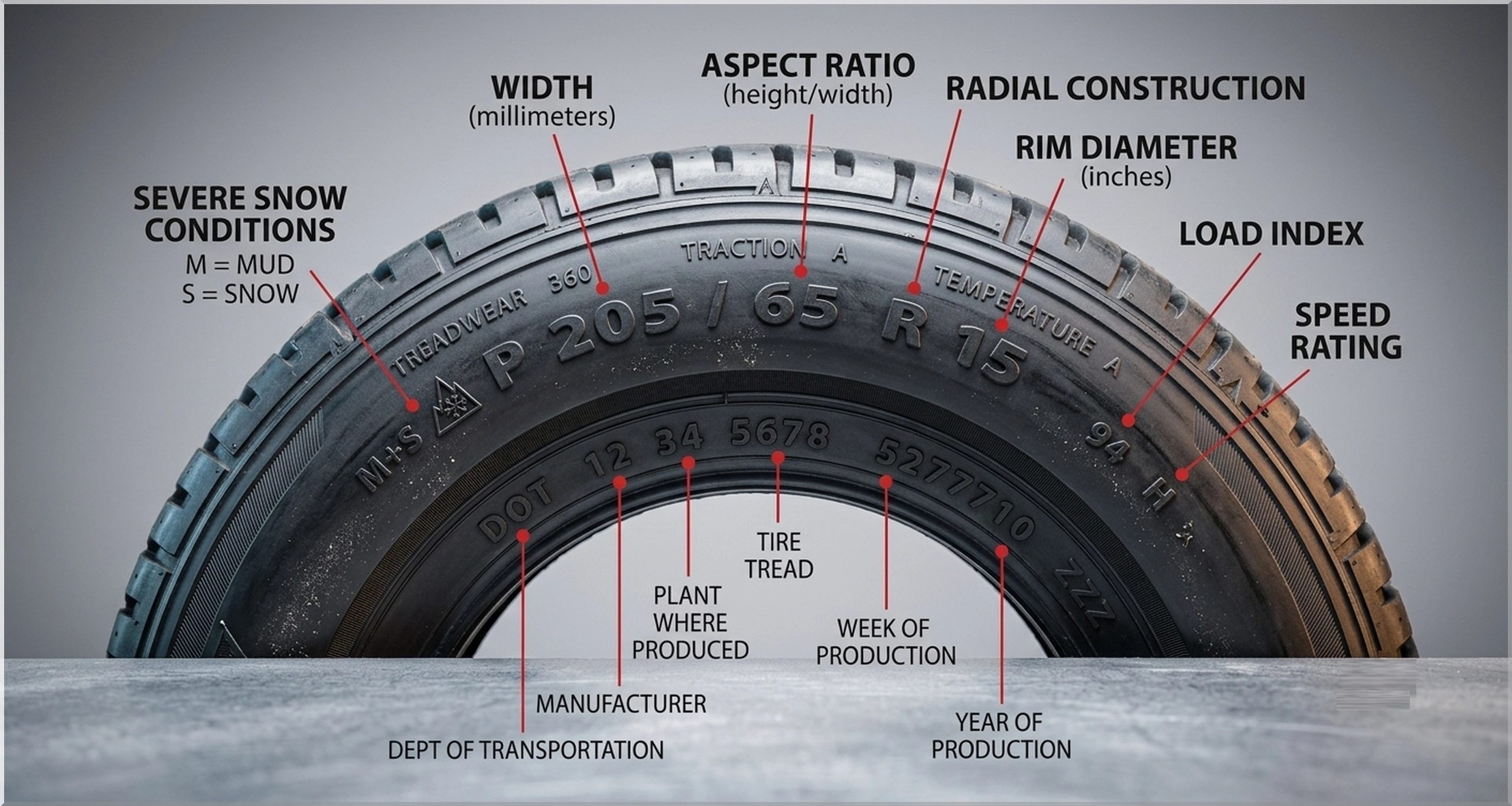
In 225/65R17, the first number, 225, shows the tire's section width in millimeters. A 225 tire measures wider than a 215 tire, but real-world width can vary slightly by tire model and wheel width.
For daily drivers, do not chase a wider tire unless the vehicle manufacturer allows that size. A wider tire can rub the fender liner, change steering feel, reduce winter traction, or interfere with suspension clearance.
Image
How to read the aspect ratio
The second number shows the sidewall height as a percentage of the width. In 225/65R17, the sidewall height equals 65% of 225 mm.
Why aspect ratio matters
- Higher aspect ratio: Taller sidewall, more ride comfort, more cushion against potholes.
- Lower aspect ratio: Shorter sidewall, sharper response, firmer ride, higher wheel-damage risk.
That is why a crossover on 17-inch wheels often rides more comfortably than the same vehicle on large 20-inch wheels with low-profile tires.
How to read construction and wheel diameter
The R in the size code means radial construction. The number after it tells you the wheel diameter in inches. In 225/65R17, the tire fits a 17-inch wheel.
This number does not allow guesswork. A tire marked R17 will not safely fit an 18-inch wheel, and an R18 tire will not fit a 17-inch wheel. Match the wheel diameter exactly.
How to read load index
The load index appears after the wheel diameter. In 225/65R17 102H, the load index is 102. That number corresponds to a maximum load per tire when the tire has the correct inflation pressure.
Do not replace your tires with a lower load index than the vehicle manufacturer recommends. SUVs, EVs, pickups, vans, and vehicles used for towing often need higher load ratings because they carry more weight.
Common load index examples
| Load index | Approx. max load per tire | Common use case |
|---|---|---|
| 91 | 1,356 lb / 615 kg | Compact cars and smaller sedans |
| 94 | 1,477 lb / 670 kg | Compact and midsize cars |
| 98 | 1,653 lb / 750 kg | Midsize sedans and crossovers |
| 102 | 1,874 lb / 850 kg | Compact SUVs and crossovers |
| 106 | 2,094 lb / 950 kg | Larger SUVs and heavier vehicles |
| 110 | 2,337 lb / 1,060 kg | Heavy SUVs, vans, and some light truck applications |
What XL means on a tire
XL means Extra Load. It does not mean the tire is physically larger. It means the tire carries a higher load capacity than a standard-load tire in the same size when inflated correctly.
You will often see XL tires on heavier crossovers, performance sedans, EVs, and vehicles with large wheels. If your door placard calls for XL, replace with XL or a tire that meets the required load specification.
How to read speed rating
The speed rating appears as a letter after the load index. In 225/65R17 102H, the speed rating is H.
Speed ratings do not only matter for drivers who go fast. They also indicate how the tire manages heat and stress at sustained highway speeds. A lower speed rating can change steering response, braking feel, heat resistance, and vehicle behavior.
Common speed ratings
| Speed rating | Maximum speed | Typical use |
|---|---|---|
| S | 112 mph / 180 km/h | Older cars and some standard passenger tires |
| T | 118 mph / 190 km/h | Many economy cars, compact SUVs, and touring tires |
| H | 130 mph / 210 km/h | Sedans, crossovers, and touring tires |
| V | 149 mph / 240 km/h | Sport sedans and performance crossovers |
| W | 168 mph / 270 km/h | High-performance cars |
| Y | 186 mph / 300 km/h | High-performance and ultra-high-performance tires |
Can you use a higher or lower speed rating?
You can usually choose a higher speed rating than the original specification if the tire also matches the required size and load rating. Do not choose a lower speed rating unless your vehicle manufacturer or tire professional confirms that the tire fits your use case.
Winter tires create one common exception. Some winter-capable tires carry lower speed ratings than the original summer or all-season tires. If you use them, you must respect the tire's lower maximum speed.
Image
What P, LT, T, and no-prefix tire sizes mean
| Prefix | Meaning | Where you see it |
|---|---|---|
| P | Passenger metric | Cars, minivans, crossovers, and many SUVs. |
| LT | Light truck | Pickups, heavy SUVs, work vehicles, towing setups, and off-road applications. |
| T | Temporary spare | Compact donut spare tires used for short emergency driving. |
| No prefix | Metric sizing | Common on many modern passenger tires, especially European-style metric sizes. |
Do not replace an LT tire with a P-metric tire just because the size looks close. LT tires use different load/inflation requirements and suit heavier-duty use.
How to read an LT tire: LT265/70R17 121/118S Load Range E
Light truck tires add more information because they often support towing, payload, off-road impacts, and heavier vehicles.
- LT: Light truck tire.
- 265: Section width in millimeters.
- 70: Aspect ratio.
- R17: Radial tire for a 17-inch wheel.
- 121/118: Load index for single-wheel and dual-wheel applications.
- S: Speed rating.
- Load Range E: Heavy-duty load range category often found on trucks and towing setups.
How to read ZR performance tire markings
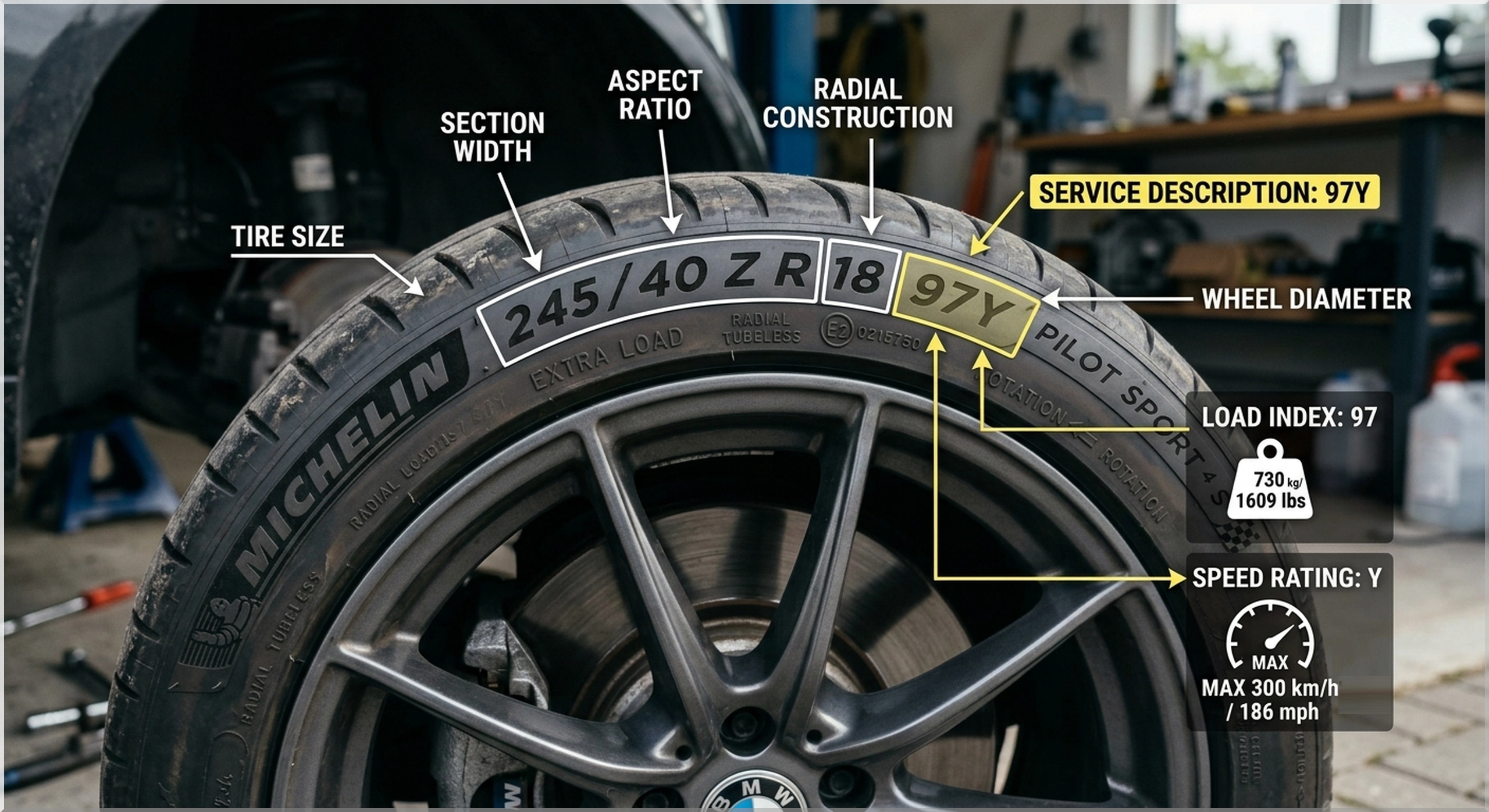
You may see a performance size such as 275/40ZR20 106Y. The ZR marking traditionally identifies tires built for very high speed capability, while the final service description still gives the actual load and speed rating.
Use the full service description, not just the ZR marking, when comparing replacement tires. For performance cars, also check whether the tire has an original-equipment marking for your brand or model.
Other sidewall markings you should understand
DOT date code
The DOT Tire Identification Number includes the tire's manufacturing date. The last four digits show the week and year. For example, 2319 means the tire came from the 23rd week of 2019.
This matters for full-size spares, collector cars, seasonal vehicles, trailers, and low-mileage vehicles. Tread depth does not tell the whole age story.
M+S and 3PMSF
M+S means Mud and Snow, but it does not guarantee tested winter performance. The 3PMSF symbol, also called the Three-Peak Mountain Snowflake, means the tire meets a standardized snow-traction requirement.
If you drive in real winter conditions, prioritize 3PMSF over M+S alone.
Max load and max pressure
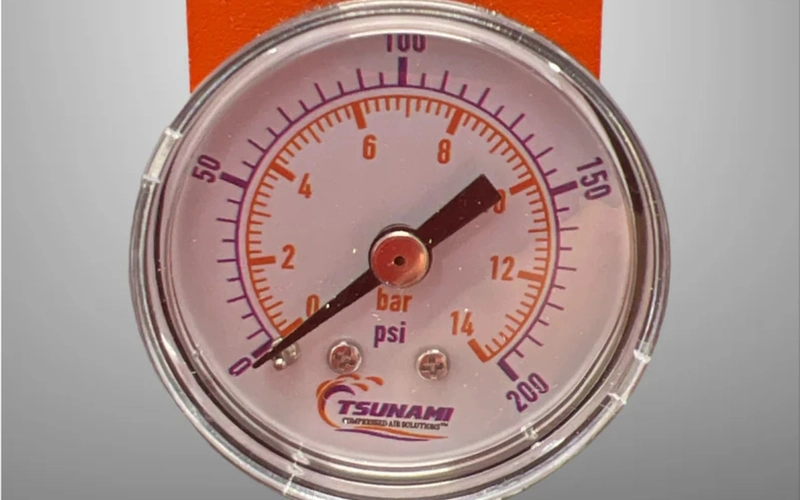
The sidewall can show maximum load and maximum pressure. These numbers define tire limits, not your daily inflation target. Use the driver door placard or owner's manual for your recommended cold tire pressure.
Outside, inside, and rotation arrows
Some tires need a specific mounting direction or side orientation. Outside must face outward on asymmetrical tires. A rotation arrow must point in the direction the tire rolls when the vehicle moves forward.
How to buy the correct replacement tire
- Start with the vehicle placard. Check the driver door jamb, glove box, fuel door, or owner manual.
- Match the size exactly. Wheel diameter must match with no exceptions.
- Meet or exceed load index. Never step below the manufacturer recommendation.
- Meet or exceed speed rating. Use caution with winter tire exceptions and respect their limits.
- Check XL, LT, or run-flat requirements. Match special requirements when your vehicle calls for them.
- Check age before installation. Use the DOT date code, especially on discounted or stored tires.
- Match pairs or sets carefully. AWD vehicles need closely matched tires to protect the drivetrain.
Pro-Tips
- Take a photo of your tire sidewall before shopping. It prevents wrong-size orders and speeds up tire-store quotes.
- Do not use the sidewall max PSI as your normal PSI. Your vehicle placard gives the correct cold inflation pressure.
- Check both sidewalls for the DOT date. The full Tire Identification Number may appear on only one side.
- EVs and hybrids often need higher load capacity. Battery weight makes the correct load index especially important.
- Full-size spare tires age quietly. Decode the spare's date before trusting it as a long-distance replacement.
FAQs
What does 225/65R17 102H mean?
It means the tire has a 225 mm section width, a 65% aspect ratio, radial construction, fits a 17-inch wheel, has a 102 load index, and carries an H speed rating.
Can I use a tire with a higher load index?
Usually yes, as long as the tire matches the correct size and other fitment requirements. A higher load index does not increase the vehicle's legal payload capacity.
Can I use a lower load index?
No. Do not fit a tire with a lower load index than the vehicle manufacturer recommends.
Does speed rating matter if I never drive fast?
Yes. Speed rating also reflects heat resistance and structural capability, not only top speed.
What does XL mean on tires?
XL means Extra Load. The tire can carry more weight than a standard-load version in the same size when properly inflated.
What does the DOT date code mean?
The last four digits show the week and year of manufacture. For example, 2319 means the 23rd week of 2019.
Bottom line
Reading a tire starts with the size code, but safe replacement goes further. Match the vehicle's recommended size, load index, and speed rating. Check whether the tire needs XL, LT, run-flat, winter certification, or a specific mounting direction. When in doubt, trust the door placard, the owner manual, and a qualified tire professional - not a guess from a tire sidewall alone.
Image Gallery
- 430 views